Dog Omeprazole Dosage Calculator
Check the omeprazole dose your vet has advised for your dog’s weight
Last updated: 25 November 2026
Only give your dog omeprazole if your vet has advised it. When a vet does, the usual dose is 0.5–1 mg per kg of body weight, usually twice a day, given shortly before a meal.
For example, a 20 kg dog would usually have 10–20 mg per dose: one 10 mg or one 20 mg capsule. Capsules and tablets should not be split or crushed unless your vet says so. See the dose chart by weight. If your dog has eaten omeprazole by accident, contact your vet.
Important: Veterinary Consultation Required
This calculator is for informational purposes only. Never give your dog omeprazole without first speaking to a vet. Sickness, diarrhoea and tummy pain can have many causes, and some need urgent treatment rather than an acid reducer. If your vet’s dose is different, follow your vet.
Calculate Dosage
Important Safety Information
- •Only give omeprazole if your vet has advised it, at the dose they give you
- •Don’t split, crush or open capsules or tablets unless your vet says so: the coating protects the medicine from stomach acid
- •After more than 3–4 weeks, ask your vet how to reduce the dose rather than stopping suddenly
- •Tell your vet about other medicines, as omeprazole affects how some are absorbed
- •See a vet urgently for vomiting blood, black poo, repeated vomiting or a swollen tummy
- •Store all medicines safely away from pets
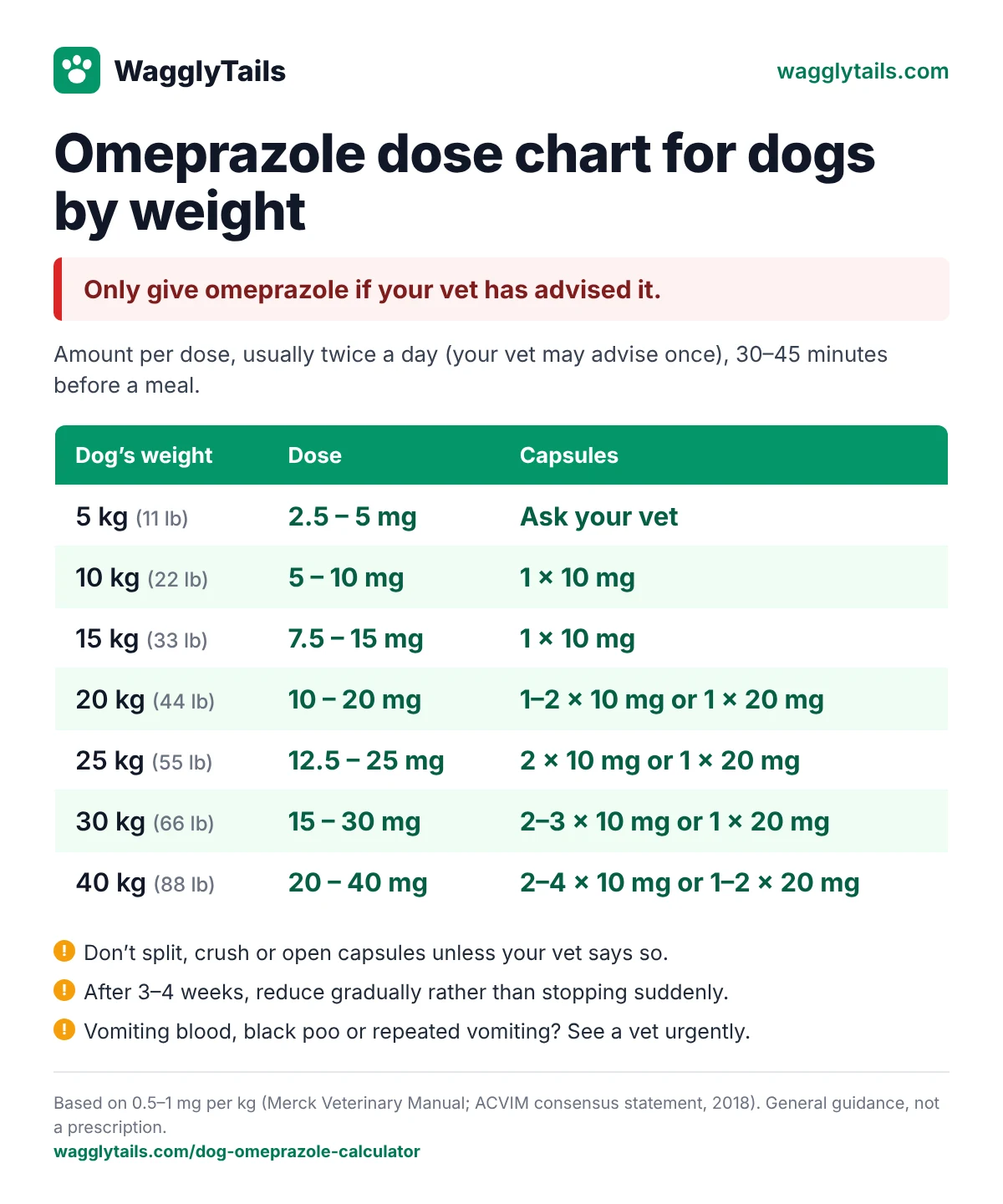
Omeprazole Dose Chart for Dogs by Weight
Amount per dose, usually given twice a day (your vet may advise once), based on 0.5–1 mg per kg. Only use this to check a dose your vet has advised.
| Dog’s weight | Dose | Capsules |
|---|---|---|
| 5 kg (11 lb) | 2.5 – 5 mg | Less than one 10 mg capsule |
| 10 kg (22 lb) | 5 – 10 mg | 1 × 10 mg |
| 15 kg (33 lb) | 7.5 – 15 mg | 1 × 10 mg |
| 20 kg (44 lb) | 10 – 20 mg | 1–2 × 10 mg or 1 × 20 mg |
| 25 kg (55 lb) | 12.5 – 25 mg | 2 × 10 mg or 1 × 20 mg |
| 30 kg (66 lb) | 15 – 30 mg | 2–3 × 10 mg or 1 × 20 mg |
| 40 kg (88 lb) | 20 – 40 mg | 2–4 × 10 mg or 1–2 × 20 mg |
General guidelines, not a prescription. Your vet may advise a different dose or how often to give it, depending on the problem being treated.
If Your Dog Has Eaten Omeprazole by Accident
Contact your vet for advice, and call straight away if your dog ate a mix of medicines or you are not sure what was in the pack.
Tell the vet your dog’s weight, the strength of the capsules or tablets (check the packet), how many were eaten and roughly when. Don’t try to make your dog sick unless a vet tells you to.
About Omeprazole for Dogs
Omeprazole is a proton pump inhibitor: it reduces the amount of acid the stomach makes. Vets prescribe it for dogs with stomach or gut ulcers, inflammation of the food pipe (oesophagitis) and acid reflux, and sometimes as part of treatment for other conditions. It is a human medicine that vets use for dogs.
Dosage Guidelines
The usual dose for dogs is 0.5–1 mg per kg of body weight per dose, usually twice a day. Specialist guidance from the American College of Veterinary Internal Medicine favours twice a day for treating ulcers and oesophagitis, because it controls acid better than once a day, though your vet may advise once a day for some dogs.
Omeprazole works best given shortly before a meal (about 30–45 minutes) or with a meal. After more than 3–4 weeks of treatment, vets usually reduce the dose gradually, for example by halving it each week, to avoid a rebound rise in stomach acid.
Capsules and Tablets
In the UK, omeprazole comes as 10 mg, 20 mg and 40 mg capsules, dispersible tablets and liquids on prescription, and as 20 mg tablets you can buy from a pharmacy. Most have a special coating so the medicine survives the stomach acid long enough to be absorbed. Breaking, crushing or opening them can make them less effective, so only do this if your vet tells you to. For small dogs, a vet may prescribe a liquid or a dispersible tablet.
When Omeprazole Is Not the Answer
Omeprazole is not a general remedy for an upset stomach. Specialist guidance does not support giving it routinely for mild sickness, pancreatitis or kidney disease unless there are signs of ulcers or bleeding, or for every dog taking an anti-inflammatory such as Metacam. A vet needs to work out the cause first.
Side Effects
Omeprazole is usually well tolerated by dogs. Side effects are uncommon but can include vomiting, diarrhoea, wind and a reduced appetite. Long-term use can change the balance of bacteria in the gut. Tell your vet if you notice anything unusual, or if your dog’s symptoms are not improving.
Frequently Asked Questions
How much omeprazole can I give my dog?
Only give omeprazole if your vet has advised it, at the dose they give you. The usual dose for dogs is 0.5 to 1 mg per kg of body weight per dose, usually given twice a day, though some vets advise once a day. For example, a 20 kg dog would usually have 10 to 20 mg per dose.
Can I give my dog human omeprazole?
Only if your vet has advised it. Vets often prescribe the human medicine for dogs, but the dose has to suit your dog's weight and the problem being treated, and omeprazole is not right for every upset stomach. Use plain omeprazole only, at the dose your vet gives you.
Can I give my dog 20mg of omeprazole?
Only if your vet has said so. At 0.5 to 1 mg per kg, a 20 mg dose suits dogs of roughly 20 to 40 kg. For a smaller dog it is more than the usual dose, and omeprazole capsules and tablets should not be split or crushed unless your vet tells you to.
Should I give my dog omeprazole with food?
It works best given shortly before a meal, around 30 to 45 minutes before, or with a meal. Many vets suggest giving it before breakfast, and before the evening meal if your dog has it twice a day. Follow your vet's instructions.
How long can my dog take omeprazole?
As long as your vet advises. If your dog has been on omeprazole for more than 3 to 4 weeks, vets usually reduce the dose gradually rather than stopping suddenly, because stopping suddenly can cause a rebound rise in stomach acid.
Should my dog have omeprazole with Metacam or other anti-inflammatories?
Only if your vet prescribes it. Specialist guidance does not recommend giving omeprazole routinely just because a dog is on an anti-inflammatory such as Metacam. Your vet will decide whether your dog needs it.
What if my dog has eaten omeprazole by accident?
Contact your vet for advice, telling them your dog's weight, the strength of the tablets or capsules and how many were eaten. If your dog ate a mix of medicines, or the pack may have contained other tablets, call straight away.